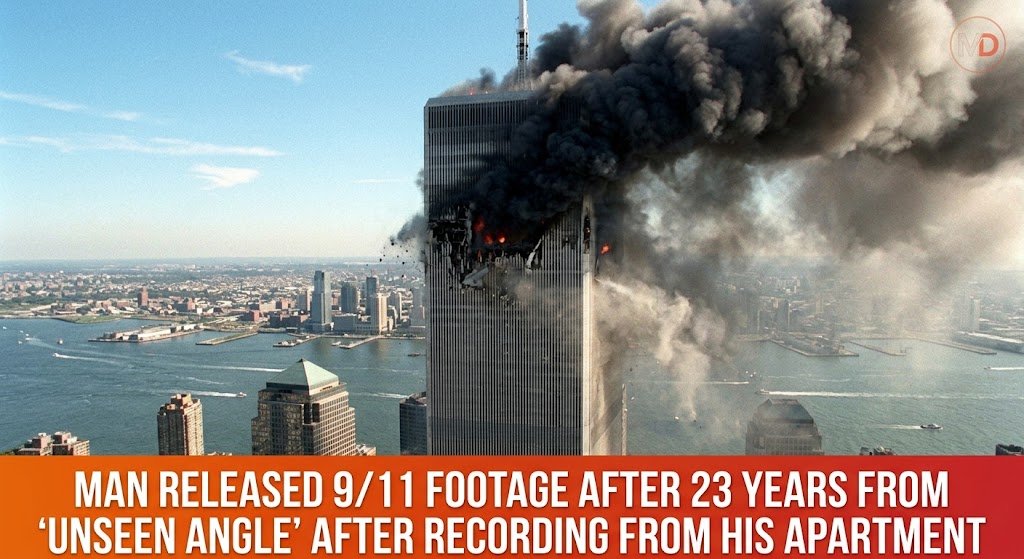
A New Yorker Found His Forgotten 9/11 Recording After 23 Years
look like. It simply observes.

The skyline stands in the distance. Smoke rises into the sky. Manhattan continues to exist around the unfolding catastrophe. And because the footage was recorded from an ordinary rooftop rather than from a major news organization, it carries the perspective of a private citizen who happened to recognize that something historic was taking place.
Sugimoto’s story also highlights a broader lesson that extends beyond September 11.
Millions of people have old photographs, videotapes, cassette recordings, hard drives, and other forms of personal media stored in closets, attics, garages, and boxes. Many assume those memories will remain safe simply because they are physically stored somewhere. But physical storage does not necessarily mean preservation.
A videotape does not send an alert when its magnetic information begins to deteriorate. There is no automatic notification telling an owner that a childhood recording, family celebration, wedding, vacation, or historical moment may soon become impossible to recover.
That is what makes Sugimoto’s discovery particularly significant.
Had he waited another few years, the World Trade Center recording might have been among the damaged tapes he could no longer recover. Instead, he found it in time to transfer the footage into a modern digital format and make it accessible to the public.
The importance of preservation becomes even more apparent as the United States approaches the 25th anniversary of the September 11 attacks.
According to the National September 11 Memorial & Museum, 2,977 people were killed across the three attack sites, including 2,753 people in New York City. Yet even after a quarter-century, efforts to identify victims continue.
In August 2026, New York City’s medical examiner announced that forensic investigative genetic genealogy had helped identify an adult woman whose name remained private at her family’s request. She became the 1,654th World Trade Center victim to be identified and the first to be identified using that newer forensic approach.
The continuing identification of victims and the recovery of Sugimoto’s forgotten recording are very different kinds of preservation. One uses modern forensic science to restore a name to someone whose identity was lost. The other uses digital technology to rescue images that were slowly disappearing from an aging magnetic tape.
But both tell the same larger story.
History does not always survive automatically.
Sometimes it survives because someone keeps looking. Sometimes it survives because technology provides a new way to recover what seemed lost. And sometimes it survives because an ordinary person happens to preserve something without realizing how important it may eventually become.
Sugimoto did not set out to create a historical archive that September morning. He was simply a 24-year-old New Yorker holding a camera and trying to document what he was seeing.
For more than two decades, the recording remained hidden inside a box.
Then, just as the physical tape was beginning to deteriorate, it was found.
Its greatest significance is not the spectacle of destruction. It is the fact that it preserves a perspective that might otherwise have vanished completely—a quiet rooftop view of Lower Manhattan recorded by someone who witnessed an extraordinary moment and pressed the record button.
The tape survived.
And because it was finally digitized and shared, that small piece of September 11 history survived with it.
Disclaimer: This article is intended solely for educational, historical, and informational purposes. It discusses public historical events and preservation technologies. All rights to third-party references remain with their respective copyright holders.