Attention Test: Can You Count the Hidden Apples in This Bowl?
Attention Test: Can You Count the Hidden Apples in This Bowl?
Taking a quick attention test during your daily routine is a fantastic way to give your brain a mental stretch. In our fast-paced digital world, our eyes constantly skim through content without truly observing details. Taking a five-minute pause to challenge your visual perception allows your mind to slow down, refocus, and practice deep concentration.
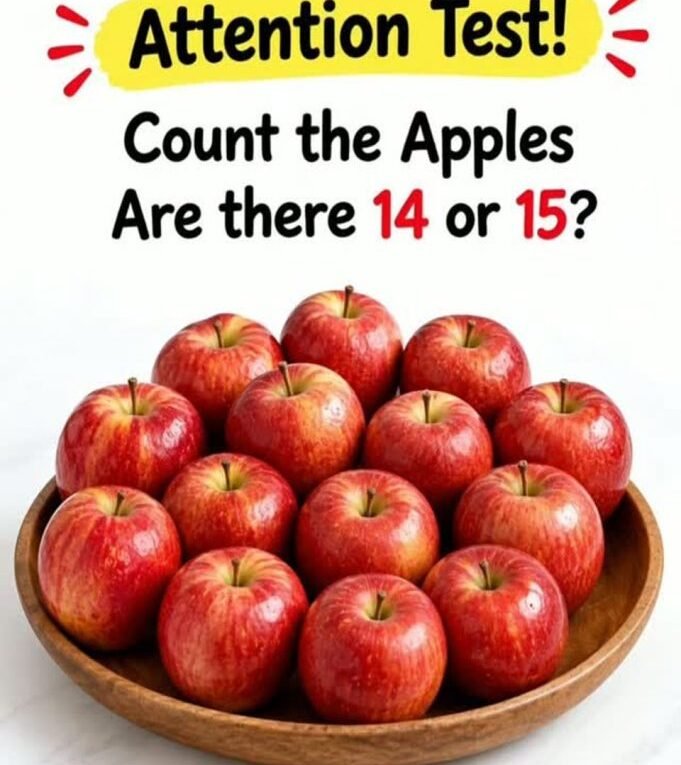
In this fun visual attention test, we present a simple yet tricky image: a beautiful wooden bowl filled to the brim with ripe, red apples. On the surface, it looks like a simple counting puzzle, but overlapping objects can easily deceive the eye.
Take a deep breath, look at the image carefully, and let us see how sharp your visual observation really is!
How to Take This Attention Test
Before you jump to a quick conclusion, remember that optical puzzles are designed to test your brain’s pattern recognition. Your mind often tries to shortcut details, which leads to miscounting. Follow these steps for an accurate result:
-
Start with the Base Layer: Look at the bottom row of the bowl. Point your finger or cursor at each apple starting from the left side and moving toward the right.
-
Scan the Middle Layer: Look carefully between the front apples. Overlapping shapes create hidden shadows where partially concealed fruit might be resting.
-
Count the Top Crown: Finally, count the apples balanced at the very top of the stack.
-
Double-Check Your Count: Reverse your direction and count from top to bottom to verify your initial number.
The question is simple: Do you see 14 apples, or do you see 15 apples?
The Psychology Behind Visual Attention Tests
Why do different people get different answers on a simple visual attention test? The answer lies in how our visual cortex processes complex scenes.
When we look at a crowded group of similar objects, our brain relies on a mechanism called visual crowding. Instead of processing every individual outline, the brain groups similar colors and shapes together to save cognitive energy.
-
Change Blindness: When objects overlap closely, our eyes tend to glaze over small gaps and spaces, causing us to miss hidden items.
-
Assumption Bias: If we see a spherical red object partially hidden behind another, our brain might automatically assume it is part of an adjacent apple rather than a separate one.
Exercising your vision with a regular attention test helps train your brain to overcome these mental shortcuts, improving your detail orientation in daily tasks.
Benefits of Daily Mental Exercises and Visual Breaks
Incorporating short visual puzzles into your workday provides surprising benefits for cognitive performance:
-
Reduces Mental Fatigue: Switching your focus from reading dense text or working on spreadsheets to a visual puzzle gives your problem-solving centers a rest.
-
Enhances Spatial Awareness: Visual counting games force your brain to map out three-dimensional depth from a two-dimensional image.
-
Promotes Mindfulness: Focusing entirely on one simple task—like finding every apple in a bowl—acts as a quick meditation exercise, lowering stress levels.
Frequently Asked Questions
What is the correct count for this attention test?
If you count every visible outline and carefully check the overlapping center layer, the actual count of apples in the bowl is 14.
Why did I count 15 apples at first glance?
It is very common to count 15! Shadow placement and overlapping curves in stacked fruit often create the visual illusion of an extra apple nestled in the middle layer.
How often should I take a visual attention test?
Taking a 3-to-5-minute break every couple of hours to engage in visual puzzles or focus exercises helps prevent eye strain and maintains productivity throughout the day.