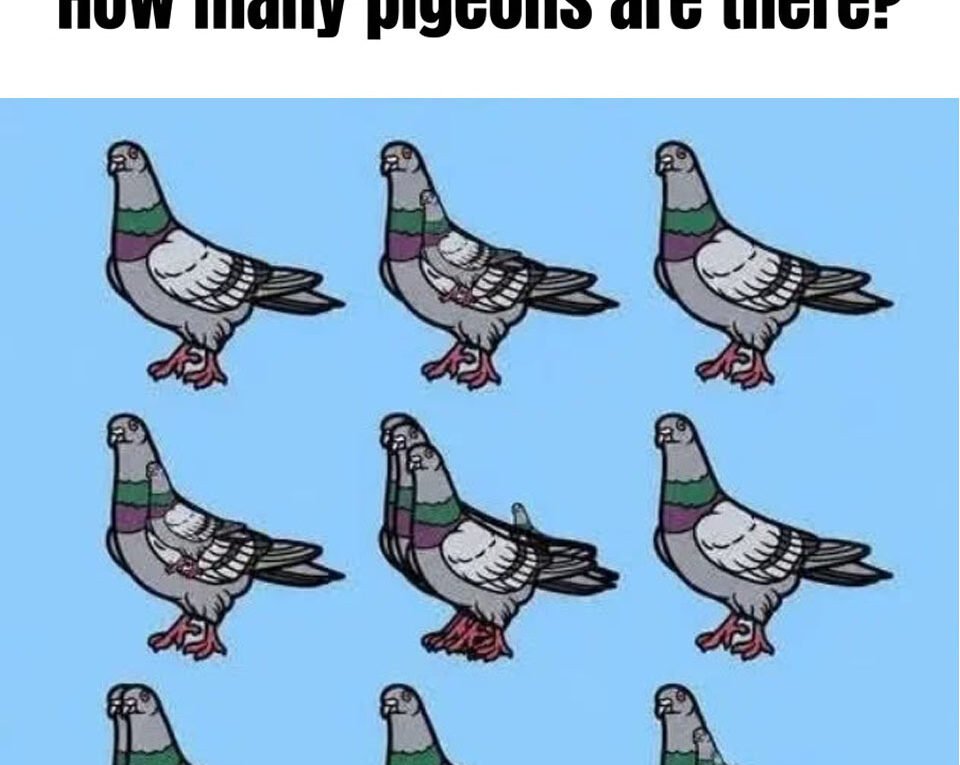
Pigeon Visual Puzzle: Can You Find All the Hidden Pigeons?
Pigeon Visual Puzzle: Can You Find All the Hidden Pigeons?
Visual games and brain teasers are one of the most effective ways to break up a busy workday and give your brain a quick mental stretch. A well-designed pigeon visual puzzle challenges your optical focus, testing whether your mind can detect subtle overlapping patterns or if it simply relies on quick shortcuts.
At first glance, this challenge looks straightforward: a collection of gray pigeons arranged across a clean, blue background. You might be tempted to count the obvious silhouettes quickly and call it a day. However, optical illusions and crowded grids are designed to deceive the human eye.
Take a close look at the grid, grab a pen to track your count, and let us test how sharp your eyes really are!
How to Solve Grid-Based Visual Puzzles
When attempting a pigeon visual puzzle or any grid-based counting challenge, speed is often your biggest enemy. Human vision relies on visual grouping, which means our brains like to smooth over crowded areas to save cognitive energy.
To ensure you don’t miss hidden figures or count the same bird twice, try these systematic counting strategies:
-
Section-by-Section Scanning: Divide the grid into four equal quadrants (top-left, top-right, bottom-left, bottom-right). Focus on one square at a time rather than scanning randomly.
-
Examine Overlapping Outlines: Look carefully at the edges of each bird. Pay close attention to double wings, extra tails, or overlapping shadows that indicate a hidden companion resting right behind another.
-
Trace the Ground Line: Check the feet and shadow placements at the base of each silhouette. Extra sets of feet are often the clearest clue that two birds are occupying the same spot.
-
Count in Reverse: Once you reach a total number, count backwards from bottom-right to top-left to verify your accuracy.
The Cognitive Science Behind Visual Illusions
Why do our minds struggle with a simple pigeon visual puzzle? The human visual processing system is remarkably efficient, but that efficiency comes with trade-offs.
-
Pattern Recognition Shortcuts: When we glance at a group of similar objects, our brain uses pre-existing mental templates to process the image instantly. If three birds are tightly clustered, the brain often registers them as a single group rather than individual items.
-
Figure-Ground Perception: Our vision distinguishes between the main subject (the figure) and the background. When shapes overlap with similar colors and contrast levels, the boundaries blur, creating hidden visual layers.
-
Selective Attention: Focusing intently on one part of an image can cause temporary “inattentional blindness,” where obvious details in adjacent areas are completely overlooked.
Regularly engaging in visual observation games helps train your visual cortex to overcome these subconscious shortcuts, improving your focus and detail orientation in everyday tasks.
Step-by-Step Breakdown: Finding the Correct Count
If you look closely at every single row from top to bottom, you will notice that several pigeons are not standing alone. Hidden buddies are nestled beside, behind, and underneath the primary silhouettes!
When you carefully isolate every overlapping wing, extra tail feather, and double outline across the entire grid, the actual count of birds in this pigeon visual puzzle comes out to 17.
Did you spot all 17 on your very first try, or did your eyes trick you into missing a few hidden birds tucked away in the shadows?
Frequently Asked Questions
What is the correct answer to this pigeon visual puzzle?
The total count for this puzzle is 17 pigeons. The extra birds are cleverly hidden through overlapping outlines, shared shadows, and tight grid clustering.
Why do visual brain teasers help improve mental focus?
Visual brain teasers require active concentration and spatial analysis. By forcing your brain to slow down and analyze small visual details, you strengthen your selective attention and pattern recognition skills.
How can I improve my score on visual counting tests?
Practice scanning images systematically from left to right or top to bottom. Avoid rushing, zoom in on crowded clusters, and look for secondary clues like double shadows or unusual borders.
Disclaimer: This pigeon visual puzzle and optical perception test is created purely for entertainment, cognitive relaxation, and lighthearted fun.